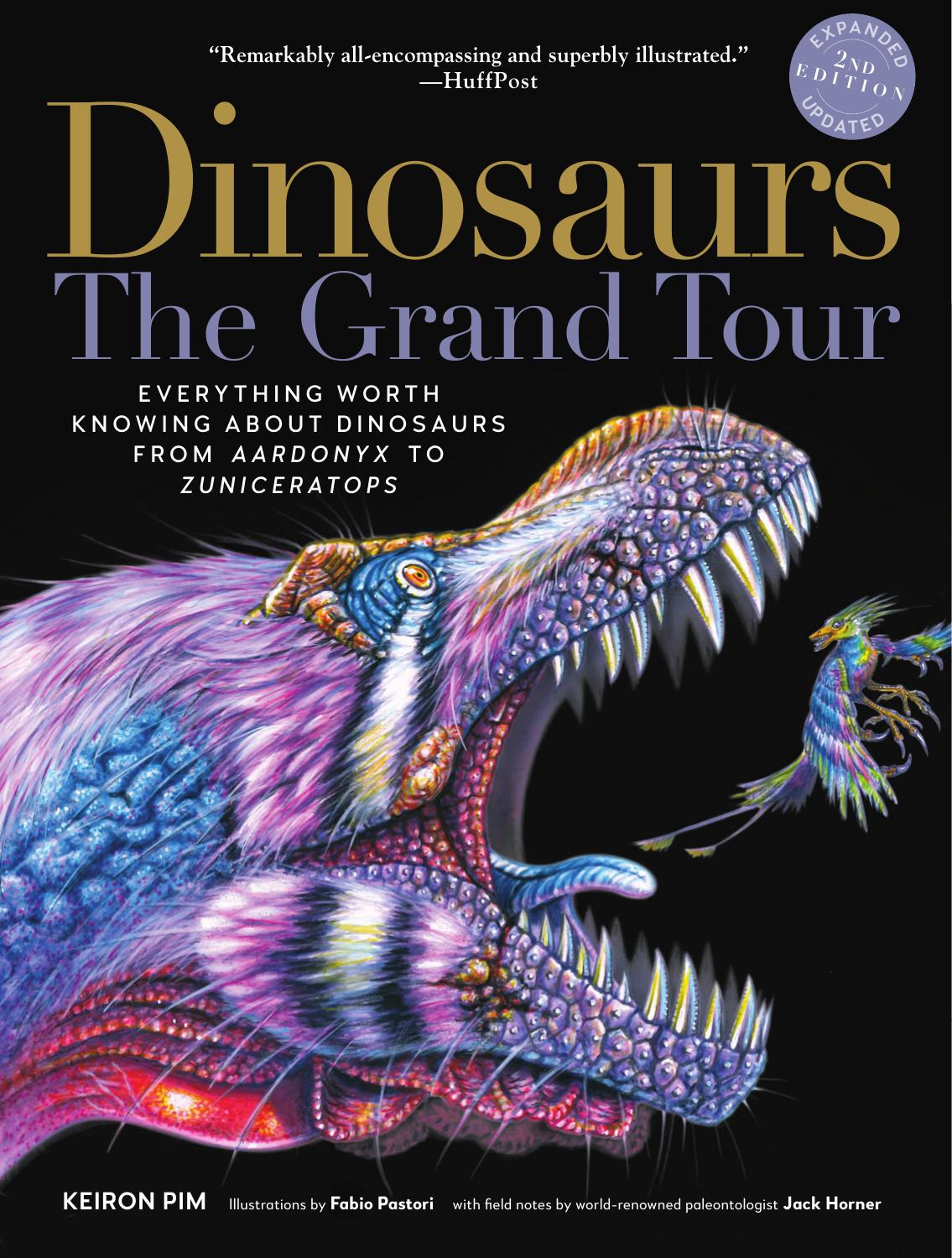
Dinosaurs - The Grand Tour: Everything Worth Knowing About Dinosaurs from Aardonyx to Zuniceratops by Keiron Pim
Author:Keiron Pim [Pim, Keiron]
Language: eng
Format: azw3, pdf
Publisher: The Experiment
Published: 2016-02-15T16:00:00+00:00
(BAR-ee-ON-iks)
BARYONYX WALKERI
First came a single terrifying claw emerging from the 130m-year-old Surrey clay . . . then a skeleton that conjured the prospect of a nightmarish predator stalking the muddy plains of southern England. Baryonyx was a spinosaur, not as immense as its later relative Spinosaurus but still a large theropod that, like the rest of its family, primarily ate fish: the presence of scales and bones belonging to the carp-like Lepidotes in the fossil’s stomach area attests to that. The story of its discovery gives hope to amateur fossil-hunters everywhere. William Walker was a plumber who scoured rock-faces for finds in his spare time, and he was exploring Smokejacks Quarry brickworks at Ockley, near Dorking, when he spied a curious lump protruding from the Wealden Clay. He broke it open to find a claw measuring 25cm (10in) long straight from base to tip, and when he alerted the Natural History Museum in London, their experts went on to procure around 70 per cent of the skeleton from the rocks. The long jaw held 96 teeth, the snout bore a small crest, and the hands had three fingers – one of which bore the ‘heavy claw’ referred to by Baryonyx’s name. This probably served a dual purpose of defence and helping scoop fish from the water into its mouth, just the same as in a grizzly bear today. Baryonyx’s discovery helped revolutionise understanding of the anatomy and behaviour of spinosaurs in general, not least its mysterious relative Spinosaurus.
Since then further partial finds have emerged in the Isle of Wight, Spain and Niger, west Africa. The original Baryonyx skeleton stayed at the Natural History Museum, where a cast remains on display as one of the most imposing and scientifically significant fossils unearthed in Britain.
Download
Dinosaurs - The Grand Tour: Everything Worth Knowing About Dinosaurs from Aardonyx to Zuniceratops by Keiron Pim.pdf
This site does not store any files on its server. We only index and link to content provided by other sites. Please contact the content providers to delete copyright contents if any and email us, we'll remove relevant links or contents immediately.
Sapiens: A Brief History of Humankind by Yuval Noah Harari(14394)
The Tidewater Tales by John Barth(12665)
Mastermind: How to Think Like Sherlock Holmes by Maria Konnikova(7353)
The Thirst by Nesbo Jo(6950)
Do No Harm Stories of Life, Death and Brain Surgery by Henry Marsh(6945)
Why We Sleep: Unlocking the Power of Sleep and Dreams by Matthew Walker(6729)
Life 3.0: Being Human in the Age of Artificial Intelligence by Tegmark Max(5560)
Sapiens by Yuval Noah Harari(5375)
The Body: A Guide for Occupants by Bill Bryson(5104)
The Longevity Diet by Valter Longo(5069)
The Rules Do Not Apply by Ariel Levy(4975)
The Immortal Life of Henrietta Lacks by Rebecca Skloot(4593)
Animal Frequency by Melissa Alvarez(4478)
Why We Sleep by Matthew Walker(4453)
The Hacking of the American Mind by Robert H. Lustig(4387)
Yoga Anatomy by Kaminoff Leslie(4370)
All Creatures Great and Small by James Herriot(4330)
Double Down (Diary of a Wimpy Kid Book 11) by Jeff Kinney(4278)
Embedded Programming with Modern C++ Cookbook by Igor Viarheichyk(4184)
